
Transform or Fade: Rethinking Product Development
The Survival Guide for Product Developers: How to Revolutionize Your Development for Value Creation and Long-Term Survival

The world isn't waiting for us to comfortably and leisurely optimize our old ways of working.
Drastic changes must be made urgently, or we will become the developing countries of tomorrow!
Since the last industrial revolution, Western industry has dominated the world. We were the heroes. Everyone envied us and gratefully accepted everything we produced.
Cars, machines, electronics, software—there was no way around North America and Europe.
But this has changed radically over the past few decades.
China, India, South America, Asia-Pacific, the Middle East, and yes, even Africa want their share of the pie and are no longer satisfied with the role of recipient and low-wage countries.
While the US tries to freeze the status quo with tariffs and force, and Europe remains petrified in a state of paralysis, I believe we must do something to maintain our competitiveness in this increasingly intense competition.
But to do this, we must radically question ourselves and make drastic changes. And we need to do it quickly!
Those who don’t question the foundation of their product development now will no longer be relevant tomorrow.
NewPDP - History
The NewPDP is a new process model for product development processes based on a study by a major consulting firm from 2022, which compared the development processes of new players in the vehicle market with the processes of established players.
This yielded a number of starting points for making the development process faster and more efficient.
On this basis, I developed this new concept, supported by my team and experienced, competent consultants. In addition to the study’s findings, we incorporated our own experiences from development projects that we’ve participated in over the past 30 years.
In 2022, the NewPDP began being applied in two projects that were selected as pilot applications. During these first years, the NewPDP continued to evolve, until in 2024 the decision matured to use it for all newly starting projects going forward.
So it's not pure theory but rather a development by a dedicated team, whom I would like to thank at this point for their courage, resilience during the early days, and persistence to see it through.
I spent a long time thinking about what name we should choose for a new product development process. It should be cool, spark curiosity, and invite participation.
In the end, I decided to stick with the rather trivial name “New Product Development Process,” because that’s what it’s about: We need to implement a new process that unites the proven and the new in one coherent concept!
However, it’s not a gradual evolution of the familiar, but truly a new process!
Even though the NewPDP won't be new forever, I'm using the name that people intuitively picked.
4 Pillars—3 Catalysts
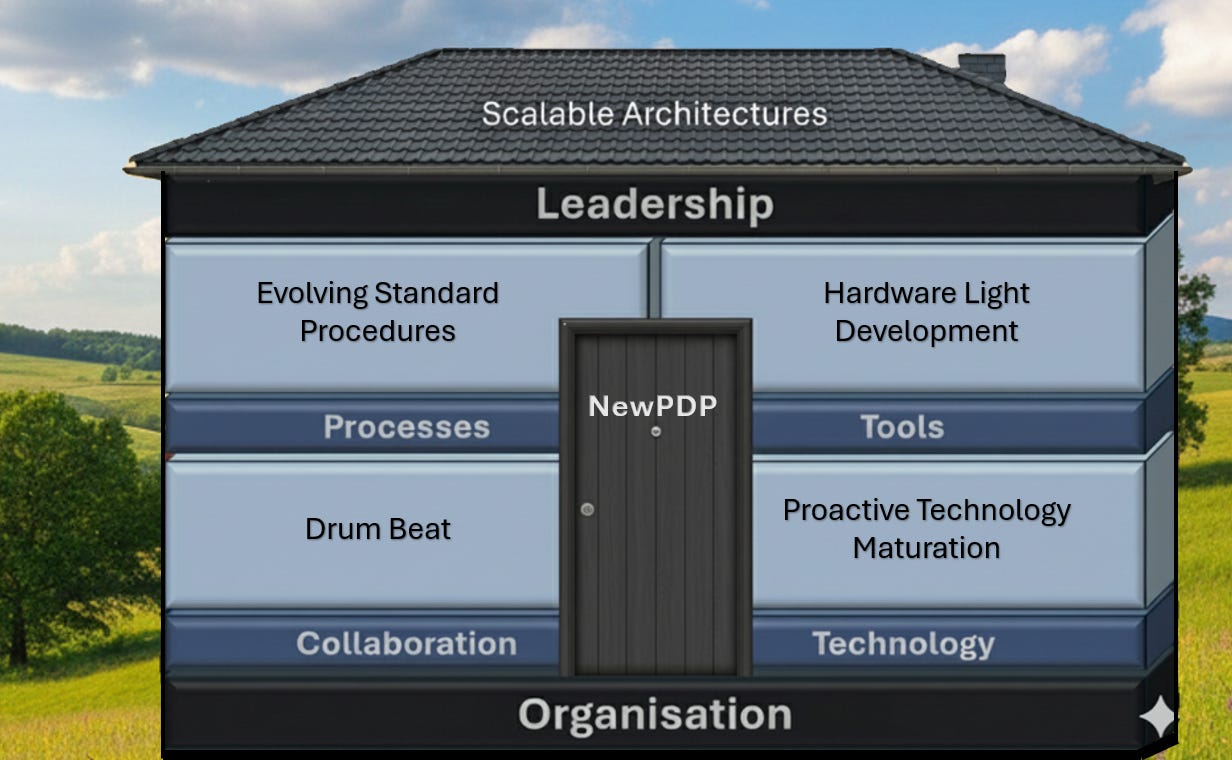
The NewPDP is based on 4 pillars—subject areas in which fundamental transformation takes place.
I will briefly describe here in this article what these subject areas are and why they are relevant. You’ll find the full content in many more Substack articles that I will write on this topic throughout this year.
In addition, there are 3 factors that must be changed to alter the boundary conditions in such a way that the transformation is sustainable in the long term.
There will also be extensive and detailed information on these.
If you haven’t already, please subscribe to my newsletter so you don’t miss these articles.
The 4 Transformation Fields of the NewPDP

Collaboration - The Drum Beat
To remain competitive, the potential and performance capability of employees and leaders must be converted into performance with a high degree of efficiency.
As an engineer, I deliberately use "efficiency" here in its physical/thermodynamic sense - the ratio of useful output to total input - rather than the broader management concepts of efficiency and effectiveness. Physical efficiency encompasses both: achieving maximum benefit with minimal effort by doing things right and doing the right things. In this context, energy and human potential can certainly be equated.
I like the analogy with a machine. A well-designed machine converts the energy used into usable performance with as few losses as possible by meticulously optimizing the interaction of all machine elements in detail.
That’s exactly what we need to achieve with human potential. The performance capacity (energy) that lies within people must be converted into maximum performance.
The NewPDP approach to efficient collaboration is the Drum Beat. This method achieves synchronization, value stream orientation, and speed that were not achieved with classic project management models.
It’s not an absolute reinvention, but rather crystallizes the essential core from many management methods that is relevant and effective for high efficiency.
It combines culture and operational procedures into a coherent method that is both practical and continuously improvable.

Processes - Evolving Standard Procedures
Yes, I admit, this is not a new invention either.
Workflows have been able to be improved with Lean Management methods for many years. This saves resources and increases speed—exactly what we need.
We just haven’t sustained it with the necessary consistency in the past.
So we need to tackle this again and really do it sustainably.
Standardizable workflows must be standardized and optimized through a continuous improvement process.
What was true in the past is still true today. Continuously improving the same workflows brings professionalism, which in turn brings speed and efficiency.
Clearly assigned resources, well-practiced processes, and continuous improvement work wherever the environment is stable and predictable. Let’s face it, not everything is volatile and unpredictable.
Evolving Standard Procedures involves systematically identifying processes suited for standardization, establishing standard procedures, and continuously refining them through iterative improvement.
It’s not just new, groundbreaking innovations that are necessary to survive in an increasingly competitive field.
It’s also the tried-and-true approaches that must now be implemented consistently and without lazy compromises.
I will write extensively about this because we must finally understand what prevented our success. Only by addressing these root causes and getting it right this time will we achieve the results we need to survive.
Technology - Proactive Technology Maturation
We are currently experiencing a technological revolution unfolding on multiple levels simultaneously:
The energy transition and electrification of formerly fossil-fueled applications
Artificial intelligence taking work off people’s hands and enabling previously unthinkable functions and features
These are just the most obvious technology fields already putting us under pressure today. But there’s more on the horizon:
Quantum computing
Space and satellite technology
Nuclear fusion
...
What makes this truly transformative is that these new technologies will fundamentally reshape even well-established fields. Materials science, mechanics, mechatronics—everything will change as a consequence.
For us developers, this means we must deal with an immeasurable number of new, immature, and poorly understood technologies while simultaneously bringing products to market that are just as reliable, powerful, and user-friendly as before.
Well, probably the previous level isn't even sufficient when the competition raises the bar, as we can already observe throughout the industry.
This field will decide between survival and death. So our NewPDP must also offer different and more future-proof approaches here if we want to be among the survivors.
Predictive Technology Maturation is a staged process that advances emerging technologies through deliberate, well-timed steps—not as fast as possible, but at precisely the right pace—to achieve the required maturity exactly when needed for product development, while minimizing investment risks from misjudgments.
Uncertainties and misjudgments are inevitable. This is why timing and investment decisions must be smart and well-measured.
This pillar is truly innovative and visionary. It transforms not only the technical dimension but fundamentally reshapes how we financially evaluate and fund technologies—a paradigm shift essential for future competitiveness.

Development Tools - Hardware Light Development
It’s only been about 40 years since the transformation from working with slide rules and drawing boards to working with computers took place.
I can hardly believe that I experienced this myself at the beginning of my professional career.
Today it’s normal for us to sit in front of a 2D screen and create three-dimensional products in the computer.
But now the next transformation is at the door!
We as engineers will become part of the virtual world and develop products in the metaverse!
Hardware Light Development is the systematic reduction of physical prototyping to an absolute minimum by utilizing virtual prototypes, digital twins, and computer-aided simulation in a virtual development environment.
Working with hardware prototypes currently determines development time and costs when developing mechatronic products. The efficiency gains from a transformation to a hardware-free development process are gigantic.
Anyone who sleeps through this will be left behind—I have no doubt about that.
However, this is no walk in the park. The subject matter is complex, and it’s not just about applying new technologies, but also about completely new thought structures and approaches.
That’s why I also chose Hardware Light Development instead of Hardware Less Development. Let’s see how far the journey takes us.
In any case, we now urgently need to pack our bags and get on the road, otherwise the train will have left and we can only wave at it from the platform.
3 Catalysts of the NewPDP
In addition to the 4 transformation fields, we must also deal with 3 aspects that must also undergo fundamental transformation for a company to function in this new environment.

Organization
We all know the classic organizational forms:
Functional organization
Divisional organization
Matrix organization
We also all know the disadvantages inherent in these principles. I’ll just say: silo thinking and complex responsibility models!
However, there are also many reasons why these organizational forms are repeatedly chosen despite their disadvantages.
Alternatives that typically emerge in software startups have not yet achieved this breadth of application.
I’m clear that the disadvantages of classic organizational models are no longer bearable in our future competitive environment. We need better alternatives.
The 4 transformation fields offer the opportunity to create conditions under which new organizational forms become possible.
A symbiosis emerges: The transformation fields require new organizational forms but simultaneously enable them.
You see, this will be an exciting aspect that I will explore.

Leadership
The situation is similar with leadership models:
Detailed job descriptions, management by objectives, promotion as a reward for good work are methods that even the youngest among us should have experienced firsthand.
But here too, there are serious disadvantages that make our organizations slower and less capable than they can be.
Examples? Endless reporting meetings and showing off for career advancement, micromanagement, timidity, and bureaucracy. All phenomena for which there is no room in the future.
Here too, we need alternatives. That’s why this aspect will occupy an important space in my future articles.

Product Architecture
Let’s come to the last point for today.
Over the past 100 years, modularization and variant management have occupied us. Both originated from the increasing complexity of hardware variants.
While there was little product variation at the beginning of the last millennium, it has grown exponentially.
It was a competitive criterion to precisely meet customer needs through products increasingly tailored to specific customer requirements.
Since the focus during this time was on mechanical products and in later years on mechatronic products, the competence had to be developed to create many product variants with few parts.
The problem was met with modular product architectures.
Although variance will by no means decrease but will continue to grow exponentially, product architectures will change significantly.
Known technologies will be replaced by new ones, creating the need for new architectures. However, these will initially be just as poorly understood as the new technologies themselves.
At the same time, the role of software in meeting customer requirements will increase significantly, and the role of hardware will be reduced, though not disappear.
In short: Modularization will no longer be enough! Modern product architectures will look fundamentally different.
We’re already observing this in vehicles: The Software Defined Vehicle follows different architectural principles. We’re experiencing firsthand how difficult it is to find the philosopher’s stone.
While some of us are still trying to realize the modularity architectures that would have been appropriate 20 years ago, they actually need to jump into the cold water of architectural transformation without having properly learned to swim.
Outlook
As this overview demonstrates, the NewPDP is a comprehensive and profound framework that warrants much deeper exploration.
In the coming articles, I will examine each topic area and transformation aspect in detail.
Many of these topics can be viewed controversially, and I welcome an intensive exchange of ideas. I would be grateful for comments, opinions, and differing perspectives. I'm also happy to answer any questions you may have.
I will incorporate the identifier buttons that I used in this article into my articles so that you can more easily assign the respective articles to the subject areas.
Although the NewPDP has been maturing for several years, there is still plenty of room for further concretization, operationalization, and adaptation to rapidly accelerating developments.
Please don’t hold back with feedback and suggestions for improvement!
I would like to be involved when you successfully future-proof your companies and make life difficult for the esteemed new competitors. Please contact me if I can help you.
If you liked the article or have questions or comments, please write them to me in the comments. I appreciate every comment.
We can of course use the chat function to exchange ideas directly.

If you liked the article, please share it with others.
I’d be very grateful if you shared my newsletter with your friends and colleagues.