
The Universal 4-Stroke Cycle — DCVI
4 strokes that always work when results truly matter.

The time when I went to school is a long, long time ago.
Most of what I learned back then I’ve long forgotten. A lot of it I never needed.
But there was one structure that was drilled into me so thoroughly that I can still recite it in my sleep.
Whether math or physics, every problem was solved the same way:
Write down what is given. Extract all information from the problem statement and list it clearly and explicitly.
Write down what is being asked. Read the question carefully. What exactly is required?
Describe the way of creating the solution step by step. Don’t skip steps. That costs points in the exam.
Check your result. Does it make sense? Try a different approach to estimate whether the result could be correct. If the check confirms the result, underline it twice.
Write a concluding sentence that puts the result back into the context of the problem statement.
Do you know it too? If so, write it in the comments.
I thought it was harassment. Unnecessary stress. A ritual that was invented only to annoy the students but is necessary to get the marks.
The moment I entered real life, I threw the whole system overboard.
I had some brilliant ideas in mind and wanted to put them into action as soon as possible, without bureaucracy and red tape.
Only to find out it didn’t go as smoothly as expected. Loops. Setbacks. Poor results. The full program.
Until one day I realized: the structure from school is built on a universal principle. One that works miracles in real life.
I call it the Universal 4-Stroke Cycle.
I can’t quite shake the automotive engineer in me — but trust me. This 4-stroke principle works everywhere. Not just in engineering.
You Already Know This Principle
I’ll make a prediction: you already know this principle. You already apply it.
After reading this article — or maybe even while reading it — you’ll say to yourself: “That’s obvious. I’ve been doing this for years. At work, in my free time, in my personal and family commitments.”
Look at it anyway. And ask yourself honestly: do you apply it consistently and deliberately? Or only intuitively, sometimes?
I promise you this:
With this principle, success is no longer a matter of luck. It becomes something you can control.
That is not a marketing claim. It is the truth.
It takes practice and method to get there, which is why I will be spending more than just this one article on the topic. The devil, as always, is in the detail.
Subscribe so you don’t miss what’s coming.
But let’s not start with the details. Let’s start at the beginning.
What Is the Universal 4-Stroke Cycle?
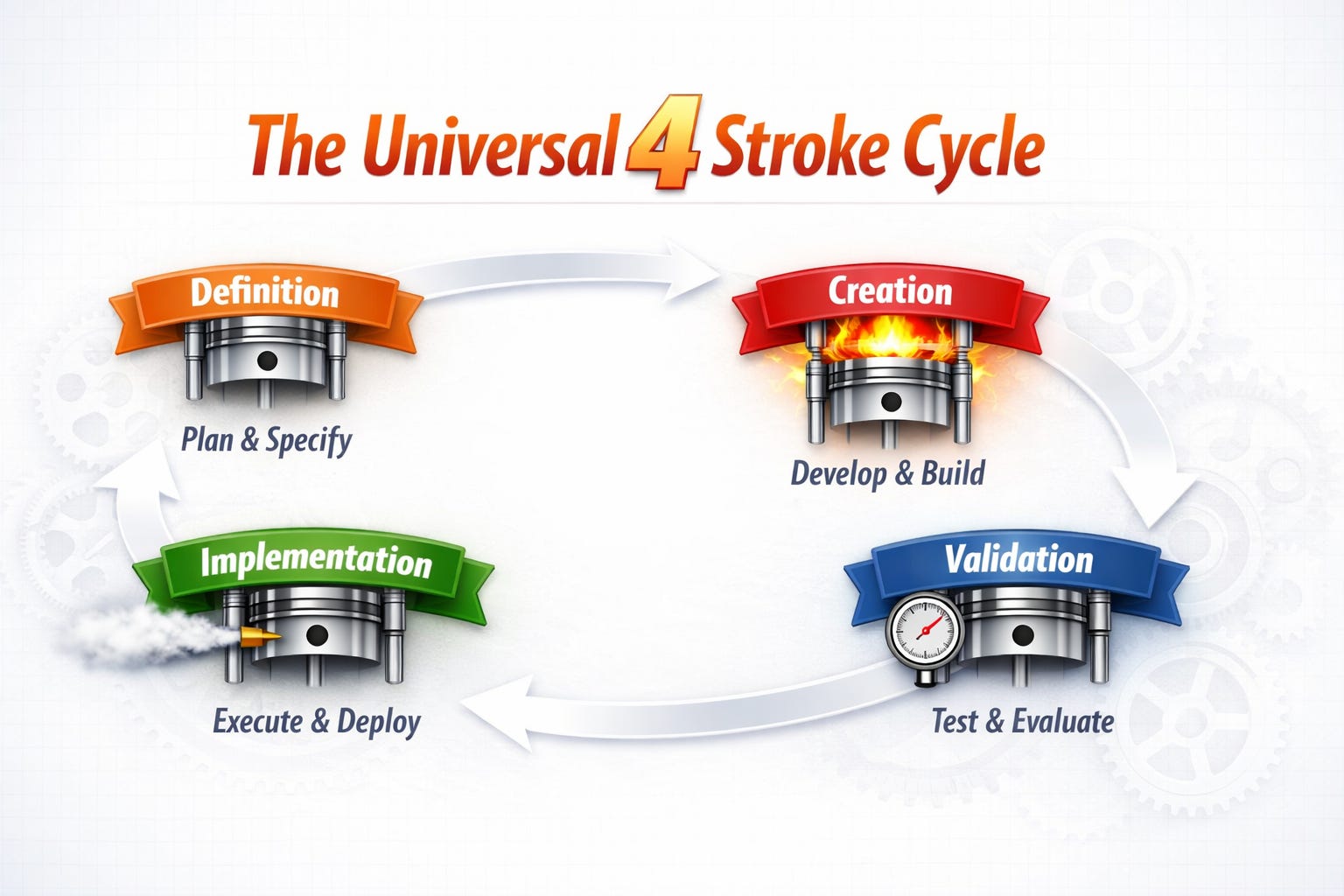
The Universal 4-Stroke Cycle consists of four strokes:
Definition. Creation. Validation. Implementation.
DCVI.
I have written about DCVI before, specifically in the context of product development.
If you’ve read that article and go back through the others, you’ll find this principle appearing again and again, sometimes explicitly, sometimes implicitly.
That’s not a coincidence. It’s universal. Which is exactly why it keeps showing up. Applied by me, and by many others who don’t even know the name.
The Four Strokes
Definition
The Definition phase is about gaining clarity and preparing for execution.
“Given” and “sought” are worked out.
What information is available that’s relevant to solving the problem?
What prerequisites need to be in place before a solution is even possible?
And most importantly: what should the outcome be?
Who needs it, and what for?
If the prerequisites aren’t there, they need to be organized before the search for a solution begins.
This is, in essence, the planning phase.
There are many tools and methods that support it: Systems Thinking, Systems Engineering for specifications and interfaces, market research, Design of Experiments, and more.
The check question whether the Definition phase is complete:
Do we know everything we need to know, and have we made every decision that needs to be made, so that we can work toward a solution with clear direction?
This phase is cut short far too often.
It feels inefficient because there’s no solution yet.
The pressure to start building is enormous. So the preparation gets shortened.
That is a serious mistake!
The courage to go slowly here pays back many times over.
The time invested in Definition saves far more time later, by avoiding the costly loops and roadblocks that come from starting without clarity.
Creation
In the Creation phase, the solution is developed.
Step by step. Just like in school. Skipping steps feels like a shortcut. It almost never is.
The assumption “I already know what the next outcome will look like” is wrong more often than people think.
By the time the error is discovered, time has been lost, and fixing it requires jumping back in the process.
That wastes far more time than simply confirming each intermediate result as you go.
That said: loops are allowed in this phase.
Deliberately exploring different approaches, evaluating them, and selecting the best one is exactly what Creation is for.
And it requires teamwork.
Not: “Leave me alone, my work is none of your business.”
But: full transparency, collegial support, and shared decision-making.
Everyone working toward the best possible solution together.
The check question whether the Creation phase is complete:
Are we confident, in principle, that we have found the best solution possible for this problem given the available conditions?
Validation
The Validation phase is the proof.
Now it’s time to verify that the solution actually works in reality as required.
Changes are only permitted if problems are identified that must be corrected. Late optimization changes introduce new risks, and at this stage, those risks cannot be properly managed.
In engineering, we literally call this activity validation. The product is tested under real or close to realistic conditions.
In other contexts, validation happens through shared review: discussing the solution with customers, users, or experts who know the domain and can provide a meaningful benchmark.
The check question whether the Validation phase is complete:
Are we sufficiently confident that we have the best solution available, one that will not cause unmet requirements or quality problems in real application?
Implementation
Implementation is the concluding sentence.
The result is delivered into reality. A solution is only effective when it has reached the customer or user and been accepted.
In large projects, completing this phase is taken for granted.
If the product doesn’t reach the customer, no money flows. The consequence is obvious.
In many other situations, it’s less clear-cut.
Results get left somewhere. They exist, but they don’t arrive where they’re needed. The work is done, but it has no effect.
A result that doesn’t reach its destination is not a result. It is unfinished work.
Even when the mind is already racing toward the next improvement, this phase deserves the same discipline as the ones before it.
The check question whether the Implementation phase is complete:
Has the result been delivered to the people who need it and is it applied effectively?
Why It Is Universal
I used DCVI in product development at Mercedes-Benz Trucks for many years.
At first intuitively, then increasingly consciously and with structure, until I gave it a name and a process description.
Large projects. Hundreds of people involved. Millions in investment.
It worked where it was applied. It worked less well where it was neglected.
But I have observed and used this principle in many other contexts too.
Whether an organization is being modernized, IT is being improved, processes are being optimized, costs are being reduced, or strategy is being revised, the Universal 4-Stroke Cycle makes every initiative structurally sound and independent of chance.
Apply it to your business. All of it. Not just product development.
What Do We Take Away Today?
• DCVI — Definition, Creation, Validation, Implementation is a universal principle that applies to every project, task, and initiative, in business and in life.
• It makes results reliable and effective.
• Like the four-stroke engine, all four phases are required.
• It is a sequence; each phase must be completed before the next one begins.
• It is a repetitive cycle that continuously repeats itself, both in detail and in the broader, overarching context.
• The definition and implementation phases are often overlooked, but they are precisely what drive efficiency.
• With this principle, success is no longer a matter of luck. It becomes something you can control. But it takes practice and consistent application.
What is your assessment? Are you already applying the universal 4-stroke principle, or is there still room for improvement?
Write me a comment or send me a message. I read everything.

In the next article, I will show how the Universal 4-Stroke Cycle and the Pomegranate Tree Model work together as a complete system.
If you don’t want to miss it, please subscribe to the newsletter.
If you found this article helpful, don’t forget to share it with others who might benefit from it too.
And if you like my newsletter consider sharing it with others as well: